
This is a working proposal. Open it full size and try the pricing yourself.
Dunmarrow Civil station accessibility proposal
A civil contractor was responding to a transit authority’s solicitation to put step-free routes into four stations while the trains kept running. The proposal follows the authority’s section order, and its station plan is a trip the reader takes, today and after, on one section drawing.
We never share client details, so every proposal here is a mockup of how we design.
Government contracting · 79 steps at Quoin StreetAll the work
 Open the live proposal
The deal
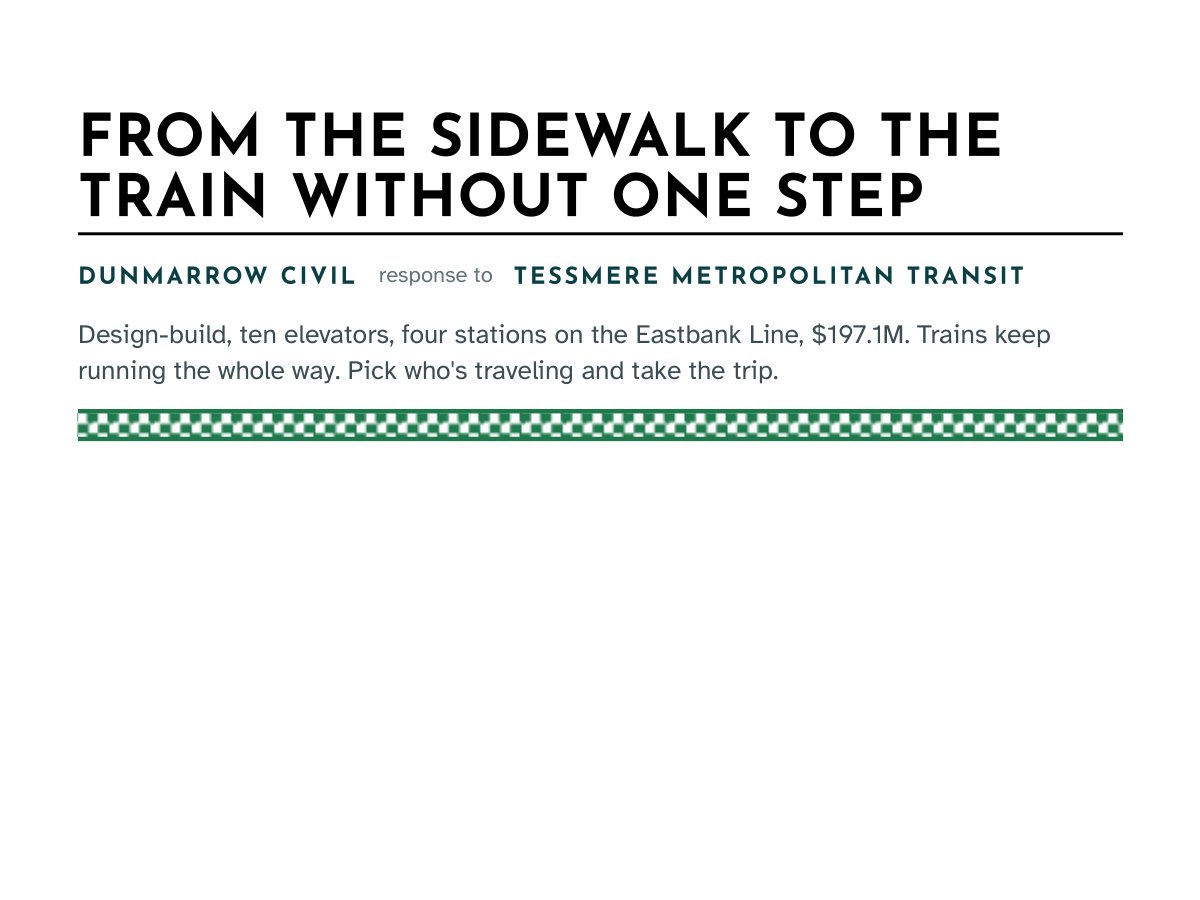
Dunmarrow Civil answering Solicitation TMT-DB-26-0417 from Tessmere Metropolitan Transit, for ten elevators at four Eastbank Line stations without stopping service for a whole week.
What the evaluators needed to see
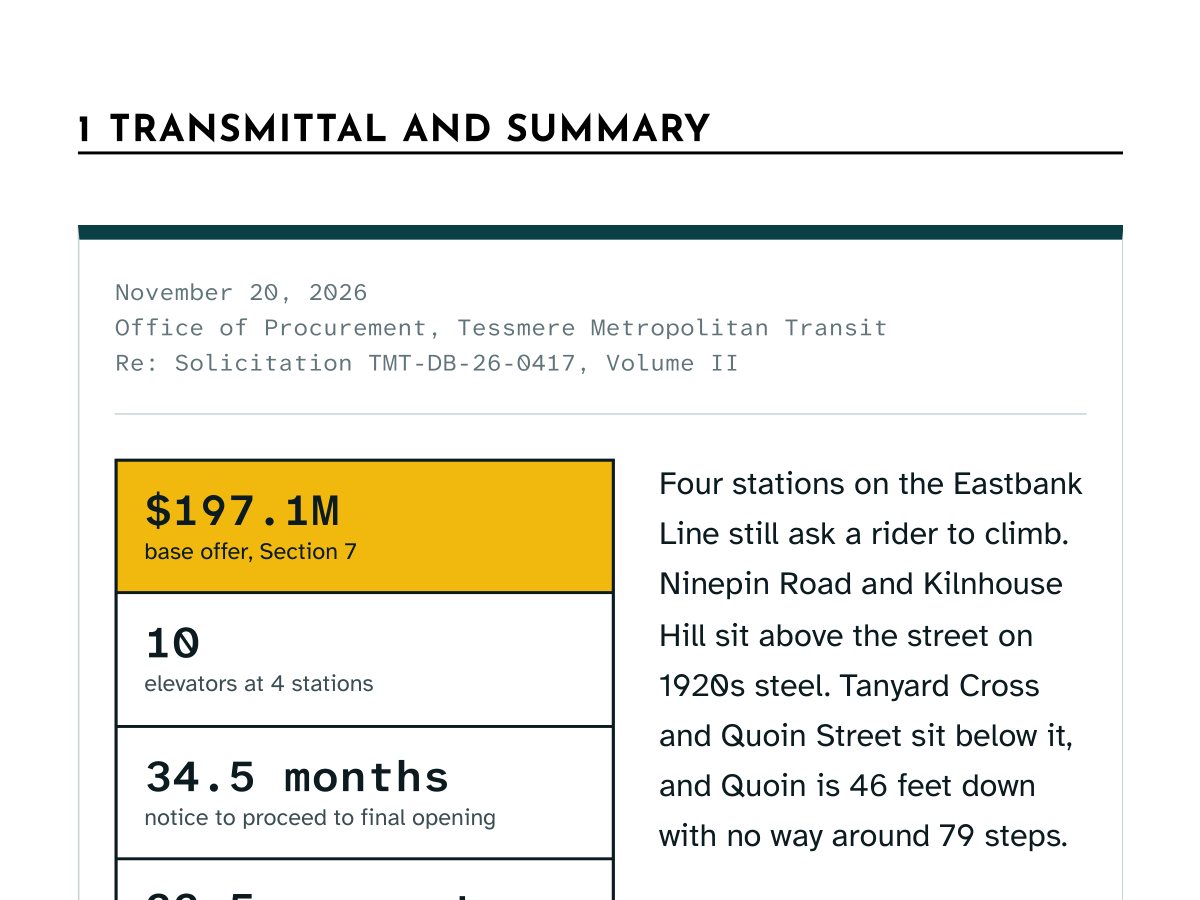
The price, the time and the two places the bid falls short of full compliance in the first screen of reading, then proof the trains keep moving.
What we built
- A section drawing where the reader picks a rider and a station, then switches between today and after
- A week of train lines where each tapped cell books a track outage
- A compliance matrix that shows the exception in the same filter as everything else
- A wall of tiles where each one is a million dollars of the price
A rider’s arithmetic
An RFP asks for a station plan, and a plan shows where the elevator goes. This concept shows what a rider does on a Tuesday morning. At Quoin Street, 46 feet down with 79 steps, the default wheelchair trip takes 21 minutes and 46 seconds today, by way of the nearest elevator 3,700 ft away at Ostlers Row. After the work it takes 3 minutes and 12 seconds. The Chief Accessibility Officer can quote that at a board meeting with its working beside it, and can then test a cab drawn at 65 inches against a 54 inch specification.
The summary states the hard parts first
A panel reads forty of these with a scoring sheet open. So the first screen of reading gives $197.1M, 34.5 months from notice to final opening, 45 days inside the 36 month limit and 22.5 percent certified firms against a 22 percent goal, plus where the bid doesn’t fully comply.
Everyone promises to minimize disruption
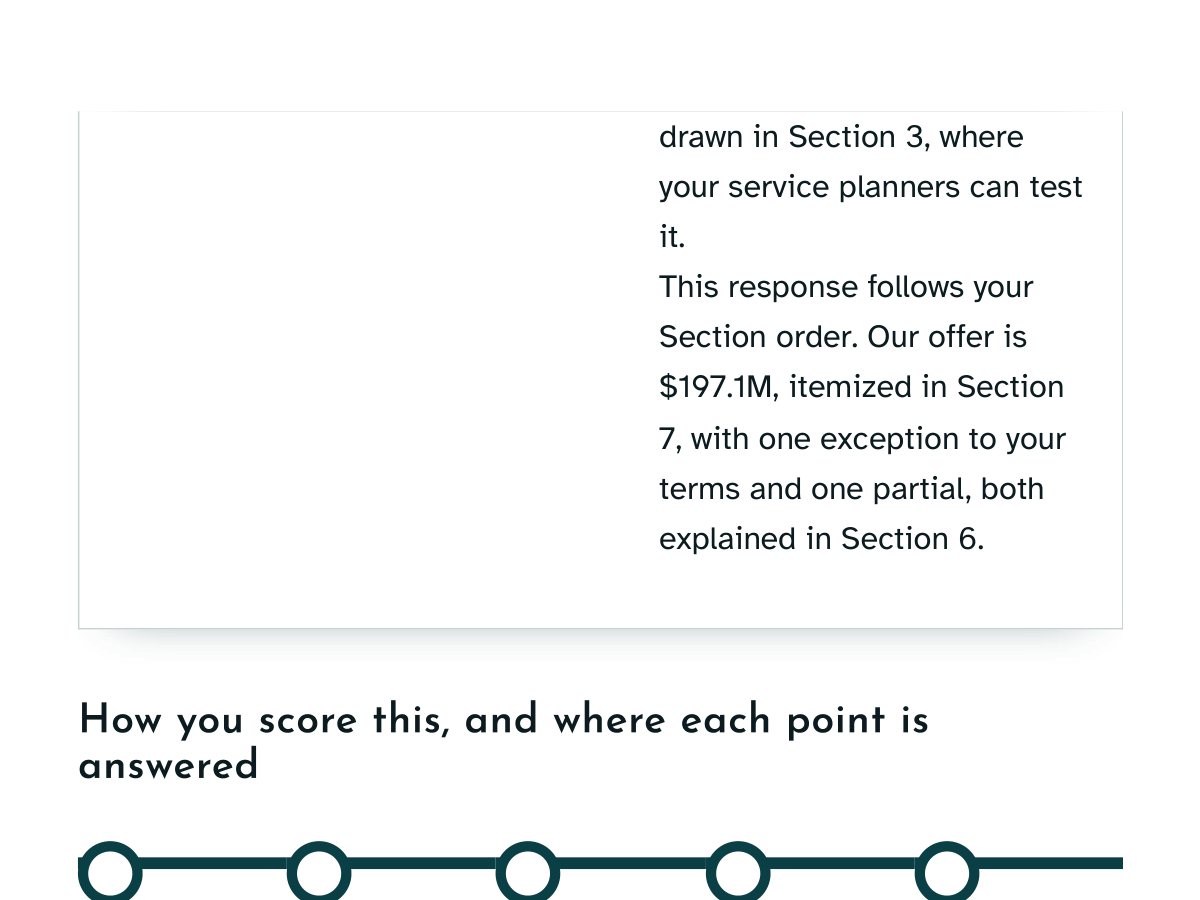
Section 3 draws it. Each hairline is a scheduled train, and the VP of Service Planning can overbook or underbook the outages. The default plan affects 24,900 trains, diverts 6.08M riders and books 3,845 productive track hours, with both zones finishing inside the 80 weeks. At Quoin Street, the hoarding held to six feet leaves a flow of 13.0 people a minute per foot.
The other three readers
- The Director of Community Affairs slides toward a closure. At the default of 30 days out, 3 of 6 notices are up and 8,200 people have been reached.
- The Chief of Capital Delivery switches on three risks against the float, with liquidated damages at $28,000 a day.
- The Contract Officer pulls firms off Form B and sees whether the $44.4M commitment still clears the goal.
The exception, with its wording
Sharing the risk on unmapped utilities is the one exception, and the matrix says why. Taking it all would add about $14M of contingency on 100 year old records.
Strike a line, or record it received
A lump sum can’t be negotiated in public, but a line can be struck, and each line says what goes with it. A second street elevator at Quoin Street sits as an $11.6M option for the board. The step asked for now is small. Record the package as received or ask a question first.
The detail that does the work
The train count and the graph come from one schedule, so the total can’t disagree with the picture.
Open it the way the buyer does.
This is the live proposal on a tablet, a laptop and a phone, the way each signer opens it. Tap any screen and it opens at true size, right here.
Every proposal ships with a matching PDF.
Open full screenThe same proposal, as a PDF.
Page for page with the live version, for the inbox, the board pack and the printer.
PDF · 23 pages
More concepts
All concepts
Cobbold Wrackline JV
Four lanes at every peak, frame by frame
$253.6Mcost understanding, against a $265M budget
Government contracting · 1,640 days under traffic · Concept work

Quade Merriott Architects
168 homes, and the panel sets rents
$22.84Mcity ask, under a $24M cap
Architecture · 168 homes on Block 418 · Concept work

Thole Ansty Architects
A science building with a third less air
$5.35Mless to build than the campus standard
Architecture · 148,000 sf on Quarry Lawn · Concept work
A civil contractor was responding to a transit authority’s solicitation to put step-free routes into four stations while the trains kept running. The proposal follows the authority’s section order, and its station plan is a trip the reader takes, today and after, on one section drawing.
Government contracting · 79 steps at Quoin StreetAll the work
Open the live proposalThe deal
Dunmarrow Civil answering Solicitation TMT-DB-26-0417 from Tessmere Metropolitan Transit, for ten elevators at four Eastbank Line stations without stopping service for a whole week.
What the evaluators needed to see
The price, the time and the two places the bid falls short of full compliance in the first screen of reading, then proof the trains keep moving.
What we built
- A section drawing where the reader picks a rider and a station, then switches between today and after
- A week of train lines where each tapped cell books a track outage
- A compliance matrix that shows the exception in the same filter as everything else
- A wall of tiles where each one is a million dollars of the price
A rider’s arithmetic
An RFP asks for a station plan, and a plan shows where the elevator goes. This concept shows what a rider does on a Tuesday morning. At Quoin Street, 46 feet down with 79 steps, the default wheelchair trip takes 21 minutes and 46 seconds today, by way of the nearest elevator 3,700 ft away at Ostlers Row. After the work it takes 3 minutes and 12 seconds. The Chief Accessibility Officer can quote that at a board meeting with its working beside it, and can then test a cab drawn at 65 inches against a 54 inch specification.
The summary states the hard parts first
A panel reads forty of these with a scoring sheet open. So the first screen of reading gives $197.1M, 34.5 months from notice to final opening, 45 days inside the 36 month limit and 22.5 percent certified firms against a 22 percent goal, plus where the bid doesn’t fully comply.
Everyone promises to minimize disruption
Section 3 draws it. Each hairline is a scheduled train, and the VP of Service Planning can overbook or underbook the outages. The default plan affects 24,900 trains, diverts 6.08M riders and books 3,845 productive track hours, with both zones finishing inside the 80 weeks. At Quoin Street, the hoarding held to six feet leaves a flow of 13.0 people a minute per foot.
The other three readers
- The Director of Community Affairs slides toward a closure. At the default of 30 days out, 3 of 6 notices are up and 8,200 people have been reached.
- The Chief of Capital Delivery switches on three risks against the float, with liquidated damages at $28,000 a day.
- The Contract Officer pulls firms off Form B and sees whether the $44.4M commitment still clears the goal.
The exception, with its wording
Sharing the risk on unmapped utilities is the one exception, and the matrix says why. Taking it all would add about $14M of contingency on 100 year old records.
Strike a line, or record it received
A lump sum can’t be negotiated in public, but a line can be struck, and each line says what goes with it. A second street elevator at Quoin Street sits as an $11.6M option for the board. The step asked for now is small. Record the package as received or ask a question first.
The detail that does the work
The train count and the graph come from one schedule, so the total can’t disagree with the picture.
Open it the way the buyer does.
This is the live proposal on a tablet, a laptop and a phone, the way each signer opens it. Tap any screen and it opens at true size, right here.
Every proposal ships with a matching PDF.
Open full screenThe same proposal, as a PDF.
Page for page with the live version, for the inbox, the board pack and the printer.
PDF · 23 pages
More concepts
All conceptsCobbold Wrackline JV
Four lanes at every peak, frame by frame
$253.6Mcost understanding, against a $265M budget
Government contracting · 1,640 days under traffic · Concept work
Quade Merriott Architects
168 homes, and the panel sets rents
$22.84Mcity ask, under a $24M cap
Architecture · 168 homes on Block 418 · Concept work
Thole Ansty Architects
A science building with a third less air
$5.35Mless to build than the campus standard
Architecture · 148,000 sf on Quarry Lawn · Concept work

What are you bidding on?
Tell us the deal in a line. We’ll read it and come back with a plan and a price.
What are you bidding on?
Tell us the deal in a line. We’ll read it and come back with a plan and a price.
What are you bidding on?
Tell us the deal in a line. We’ll read it and come back with a plan and a price.