An RFP Response Template You Can Copy

Most templates hand you a list of sections and wish you luck. This one says what each section has to do, what you can reuse and what has to be new.

Most templates hand you a list of sections and wish you luck. This one says what each section has to do, what you can reuse and what has to be new.

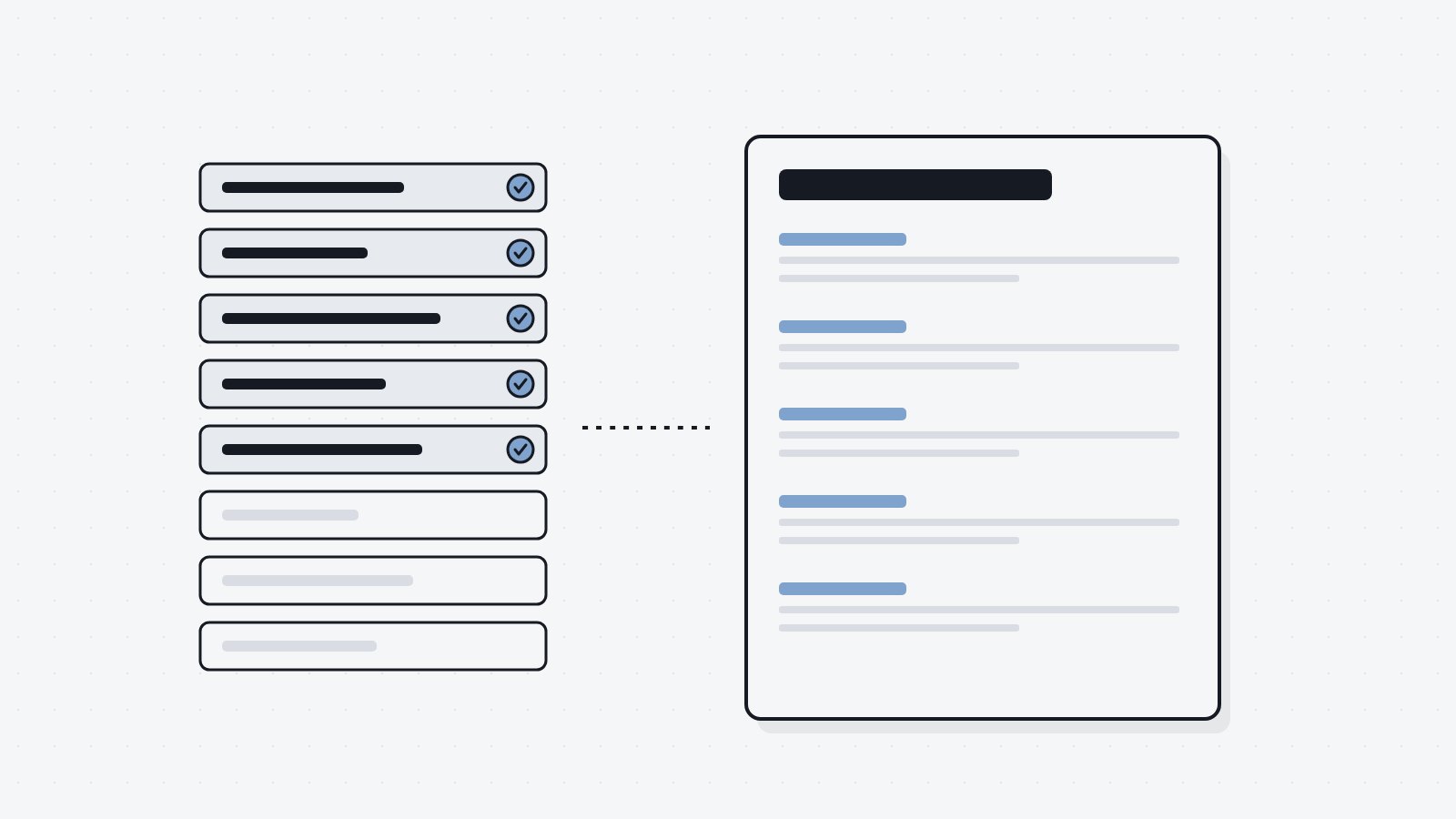
Cover illustration for An RFP Response Template You Can Copy, from the Closewell Studio blog on sales proposal design
How-to

An RFP response template is a starting structure for your reply to a request for proposals, with a place for each section a buyer usually asks for. Ours is in the table below, and you’re welcome to copy it. Use it to start fast, then give up its order the moment you’ve read the RFP, because the buyer’s numbering wins every time. The column worth your attention is the last one, which says what you can reuse and what has to be written new.

What a template can and can’t do

A template saves the time you’d spend deciding what goes where. It’s also how a response ends up sounding like the last one. A contracting officer at NITAAC, part of the National Institutes of Health, wrote a public guide to oral presentations, and in it she points out that written proposals are sometimes made by updating the last response, with the typos and the prior agency’s name still in them. She also describes responses that read like the government’s own requirement handed back as a checklist in narrative form.

That’s the kind of person reading your work. So use a template to get the reusable work out of the way, and put the hours you save into the parts a buyer can’t get from anyone else.

The RFP response template

SectionWhat it has to doReuse or write new
Cover letterName the RFP, say what you’re proposing, accept the terms and carry the required signatureWrite new. Reuse the signature block
Executive summaryGive the signer the problem, your answer, the price and the next step on one pageWrite new
Understanding of the requirementPlay the buyer’s situation back in their own words and numbersWrite new
Technical approachAnswer each requirement in the order asked, and show how you’d do itWrite new, using method notes from your library
Implementation plan and timelineGive real dates from the buyer’s start date, with an owner for each stepReuse the structure. Write the dates new
Team and key personnelShow who’d do the work, in the resume format the RFP requiresReuse resumes, then edit them for this job
Past performanceProve you’ve done similar work, with references who’ll pick up the phoneReuse from your library. Choose for fit and rewrite the opening
Security and complianceGive the certifications, policies and attestations they asked forReuse after checking every date
PricingPut your numbers on the buyer’s form, in the buyer’s formatWrite new
Exceptions and assumptionsSay plainly what you can’t meet, and what you’d accept insteadWrite new
Compliance matrixList every requirement and the page that answers itReuse the format. Fill it in new
Required formsInclude signed forms, certifications and acknowledged amendmentsReuse the list. Sign them new

Delete any row the RFP doesn’t ask for. Add any section it asks for that we didn’t list. If the buyer gives you a response form, that form is the template.

How to turn the template into this buyer’s response

  • Read the whole RFP first. Include every attachment, amendment and answer to vendor questions, and make your bid/no-bid decision before anyone starts on the outline.
  • Find the instructions and the scoring. On federal bids that use the uniform contract format, instructions are in Section L and evaluation factors are in Section M. Other buyers label them differently, so look for both.
  • Rename every heading. Use the buyer’s numbering and the buyer’s words, so nobody on the panel has to hunt for their section under your name for it.
  • Build the matrix before anyone writes. Our free RFP compliance matrix gives each requirement a row, an owner and a status, plus a checklist for format rules. Our post on the matrix explains how to fill it in.
  • Hand out pages by points. The factor carrying the most score gets your strongest writing and the most room. The Cardew Engineering concept follows the RFQ’s own order, 1 through 9, and lets a reviewer click any scored criterion to see which sections earn those points.
  • Search for the last buyer. Before you send, search the file for every past buyer’s name, the last RFP number and the last bid’s dates.

Keep a library next to the template

The template is the shell. The reusable content belongs in a second file, which most teams call a library. That’s company facts, certifications, resumes, past performance write-ups, method notes and policies. Give each item an owner and a date when it goes stale.

Then ask three questions before anything gets pasted in.

  • Is it still true today?
  • Does it mention another buyer?
  • Would this buyer’s evaluator care about it?

Past performance needs the most editing, because a story written for the last buyer rarely answers what this one asked. Our post on case studies in a proposal covers where that proof should sit.

The template on one county RFP

Here’s the county facilities RFP we load as the example in our compliance matrix. A county wants facilities maintenance at its government center. It asks for a preventive maintenance approach for all the HVAC systems in Attachment A, a staffing plan showing on-site coverage during business hours, emergency response times stated in hours, three references for contracts of similar size and pricing on its own price form, Attachment C. The technical volume is capped at 25 pages and past performance at 10, with an 11-point minimum font.

Here’s what happens to the template. Technical approach splits into section 2.1 for maintenance, 2.4 for staffing and 2.6 for response times, because that’s how the answers map to the requirements. Past performance becomes 3.1, and your library supplies the candidates, but somebody still has to choose three of similar size. Our pricing row moves to its own volume and turns into the county’s form. And the 25-page cap forces a choice about what to leave out, which you want to know in the first week.

The Greyfield Hauling concept shows where this can go. Its tabs A to K follow the order the city’s RFP sets, each scored criterion points to the tab that answers it, and the matrix names two partial answers and one exception.

The rules that can sink a good response

Format is where good work gets thrown out. Page limits, fonts, file names, portal steps, the due date and its time zone all belong in your plan on the first day. On federal work, FAR 52.215-1 makes the offeror responsible for getting a proposal to the designated office on time, and a late one won’t be considered outside a few narrow exceptions. Commercial buyers write their own rules, so read them. Then plan to submit early, because a portal upload is the worst place to find out a file is too big.

Questions we hear about RFP response templates

Should the template live in Word or in RFP software?

Either works. Word or Google Docs is fine for the shell. Software earns its cost when you answer a lot of RFPs and the library gets big enough to need search. Neither one writes the rows marked new.

How long should an RFP response be?

As long as the page limits and the points allow. If the RFP sets no limit, use the evaluation criteria to decide where the length goes.

Can AI fill in an RFP response template?

It can draft the reusable rows from your library quickly, and we think that’s a good use of it. Someone still has to check every claim and number, and the rows marked new depend on what you know about this buyer. Our post on an AI proposal workflow covers how we’d set that up.

Is a government RFP response template different?

It’s the same idea with stricter rules. On federal work, Section L tells you what to submit and Section M tells you how it’s scored. Our post on the government RFP response covers both.

The short version

An RFP response template gets you started, and the buyer’s RFP decides everything after that. Copy the table, rebuild it in their order, keep reusable content in a library and write the summary, the understanding section, the approach and the pricing new each time. Give extra care to the executive summary, since that’s the page the signer reads.

If the deal is big enough that you’d rather hand it off, our RFP response work is a Board build, from $20K, quoted by size once we’ve read the request. Send us the RFP.

Sources

More notes

All notes
Cover illustration for An RFP Response Template You Can Copy, from the Closewell Studio blog on sales proposal design
How-to

An RFP response template is a starting structure for your reply to a request for proposals, with a place for each section a buyer usually asks for. Ours is in the table below, and you’re welcome to copy it. Use it to start fast, then give up its order the moment you’ve read the RFP, because the buyer’s numbering wins every time. The column worth your attention is the last one, which says what you can reuse and what has to be written new.

What a template can and can’t do

A template saves the time you’d spend deciding what goes where. It’s also how a response ends up sounding like the last one. A contracting officer at NITAAC, part of the National Institutes of Health, wrote a public guide to oral presentations, and in it she points out that written proposals are sometimes made by updating the last response, with the typos and the prior agency’s name still in them. She also describes responses that read like the government’s own requirement handed back as a checklist in narrative form.

That’s the kind of person reading your work. So use a template to get the reusable work out of the way, and put the hours you save into the parts a buyer can’t get from anyone else.

The RFP response template

SectionWhat it has to doReuse or write new
Cover letterName the RFP, say what you’re proposing, accept the terms and carry the required signatureWrite new. Reuse the signature block
Executive summaryGive the signer the problem, your answer, the price and the next step on one pageWrite new
Understanding of the requirementPlay the buyer’s situation back in their own words and numbersWrite new
Technical approachAnswer each requirement in the order asked, and show how you’d do itWrite new, using method notes from your library
Implementation plan and timelineGive real dates from the buyer’s start date, with an owner for each stepReuse the structure. Write the dates new
Team and key personnelShow who’d do the work, in the resume format the RFP requiresReuse resumes, then edit them for this job
Past performanceProve you’ve done similar work, with references who’ll pick up the phoneReuse from your library. Choose for fit and rewrite the opening
Security and complianceGive the certifications, policies and attestations they asked forReuse after checking every date
PricingPut your numbers on the buyer’s form, in the buyer’s formatWrite new
Exceptions and assumptionsSay plainly what you can’t meet, and what you’d accept insteadWrite new
Compliance matrixList every requirement and the page that answers itReuse the format. Fill it in new
Required formsInclude signed forms, certifications and acknowledged amendmentsReuse the list. Sign them new

Delete any row the RFP doesn’t ask for. Add any section it asks for that we didn’t list. If the buyer gives you a response form, that form is the template.

How to turn the template into this buyer’s response

  • Read the whole RFP first. Include every attachment, amendment and answer to vendor questions, and make your bid/no-bid decision before anyone starts on the outline.
  • Find the instructions and the scoring. On federal bids that use the uniform contract format, instructions are in Section L and evaluation factors are in Section M. Other buyers label them differently, so look for both.
  • Rename every heading. Use the buyer’s numbering and the buyer’s words, so nobody on the panel has to hunt for their section under your name for it.
  • Build the matrix before anyone writes. Our free RFP compliance matrix gives each requirement a row, an owner and a status, plus a checklist for format rules. Our post on the matrix explains how to fill it in.
  • Hand out pages by points. The factor carrying the most score gets your strongest writing and the most room. The Cardew Engineering concept follows the RFQ’s own order, 1 through 9, and lets a reviewer click any scored criterion to see which sections earn those points.
  • Search for the last buyer. Before you send, search the file for every past buyer’s name, the last RFP number and the last bid’s dates.

Keep a library next to the template

The template is the shell. The reusable content belongs in a second file, which most teams call a library. That’s company facts, certifications, resumes, past performance write-ups, method notes and policies. Give each item an owner and a date when it goes stale.

Then ask three questions before anything gets pasted in.

  • Is it still true today?
  • Does it mention another buyer?
  • Would this buyer’s evaluator care about it?

Past performance needs the most editing, because a story written for the last buyer rarely answers what this one asked. Our post on case studies in a proposal covers where that proof should sit.

The template on one county RFP

Here’s the county facilities RFP we load as the example in our compliance matrix. A county wants facilities maintenance at its government center. It asks for a preventive maintenance approach for all the HVAC systems in Attachment A, a staffing plan showing on-site coverage during business hours, emergency response times stated in hours, three references for contracts of similar size and pricing on its own price form, Attachment C. The technical volume is capped at 25 pages and past performance at 10, with an 11-point minimum font.

Here’s what happens to the template. Technical approach splits into section 2.1 for maintenance, 2.4 for staffing and 2.6 for response times, because that’s how the answers map to the requirements. Past performance becomes 3.1, and your library supplies the candidates, but somebody still has to choose three of similar size. Our pricing row moves to its own volume and turns into the county’s form. And the 25-page cap forces a choice about what to leave out, which you want to know in the first week.

The Greyfield Hauling concept shows where this can go. Its tabs A to K follow the order the city’s RFP sets, each scored criterion points to the tab that answers it, and the matrix names two partial answers and one exception.

The rules that can sink a good response

Format is where good work gets thrown out. Page limits, fonts, file names, portal steps, the due date and its time zone all belong in your plan on the first day. On federal work, FAR 52.215-1 makes the offeror responsible for getting a proposal to the designated office on time, and a late one won’t be considered outside a few narrow exceptions. Commercial buyers write their own rules, so read them. Then plan to submit early, because a portal upload is the worst place to find out a file is too big.

Questions we hear about RFP response templates

Should the template live in Word or in RFP software?

Either works. Word or Google Docs is fine for the shell. Software earns its cost when you answer a lot of RFPs and the library gets big enough to need search. Neither one writes the rows marked new.

How long should an RFP response be?

As long as the page limits and the points allow. If the RFP sets no limit, use the evaluation criteria to decide where the length goes.

Can AI fill in an RFP response template?

It can draft the reusable rows from your library quickly, and we think that’s a good use of it. Someone still has to check every claim and number, and the rows marked new depend on what you know about this buyer. Our post on an AI proposal workflow covers how we’d set that up.

Is a government RFP response template different?

It’s the same idea with stricter rules. On federal work, Section L tells you what to submit and Section M tells you how it’s scored. Our post on the government RFP response covers both.

The short version

An RFP response template gets you started, and the buyer’s RFP decides everything after that. Copy the table, rebuild it in their order, keep reusable content in a library and write the summary, the understanding section, the approach and the pricing new each time. Give extra care to the executive summary, since that’s the page the signer reads.

If the deal is big enough that you’d rather hand it off, our RFP response work is a Board build, from $20K, quoted by size once we’ve read the request. Send us the RFP.

Sources

Share this note

XLinkedIn

More notes

All notes
Cover illustration for An RFP Response Template You Can Copy, from the Closewell Studio blog on sales proposal design
How-to

An RFP response template is a starting structure for your reply to a request for proposals, with a place for each section a buyer usually asks for. Ours is in the table below, and you’re welcome to copy it. Use it to start fast, then give up its order the moment you’ve read the RFP, because the buyer’s numbering wins every time. The column worth your attention is the last one, which says what you can reuse and what has to be written new.

What a template can and can’t do

A template saves the time you’d spend deciding what goes where. It’s also how a response ends up sounding like the last one. A contracting officer at NITAAC, part of the National Institutes of Health, wrote a public guide to oral presentations, and in it she points out that written proposals are sometimes made by updating the last response, with the typos and the prior agency’s name still in them. She also describes responses that read like the government’s own requirement handed back as a checklist in narrative form.

That’s the kind of person reading your work. So use a template to get the reusable work out of the way, and put the hours you save into the parts a buyer can’t get from anyone else.

The RFP response template

SectionWhat it has to doReuse or write new
Cover letterName the RFP, say what you’re proposing, accept the terms and carry the required signatureWrite new. Reuse the signature block
Executive summaryGive the signer the problem, your answer, the price and the next step on one pageWrite new
Understanding of the requirementPlay the buyer’s situation back in their own words and numbersWrite new
Technical approachAnswer each requirement in the order asked, and show how you’d do itWrite new, using method notes from your library
Implementation plan and timelineGive real dates from the buyer’s start date, with an owner for each stepReuse the structure. Write the dates new
Team and key personnelShow who’d do the work, in the resume format the RFP requiresReuse resumes, then edit them for this job
Past performanceProve you’ve done similar work, with references who’ll pick up the phoneReuse from your library. Choose for fit and rewrite the opening
Security and complianceGive the certifications, policies and attestations they asked forReuse after checking every date
PricingPut your numbers on the buyer’s form, in the buyer’s formatWrite new
Exceptions and assumptionsSay plainly what you can’t meet, and what you’d accept insteadWrite new
Compliance matrixList every requirement and the page that answers itReuse the format. Fill it in new
Required formsInclude signed forms, certifications and acknowledged amendmentsReuse the list. Sign them new

Delete any row the RFP doesn’t ask for. Add any section it asks for that we didn’t list. If the buyer gives you a response form, that form is the template.

How to turn the template into this buyer’s response

  • Read the whole RFP first. Include every attachment, amendment and answer to vendor questions, and make your bid/no-bid decision before anyone starts on the outline.
  • Find the instructions and the scoring. On federal bids that use the uniform contract format, instructions are in Section L and evaluation factors are in Section M. Other buyers label them differently, so look for both.
  • Rename every heading. Use the buyer’s numbering and the buyer’s words, so nobody on the panel has to hunt for their section under your name for it.
  • Build the matrix before anyone writes. Our free RFP compliance matrix gives each requirement a row, an owner and a status, plus a checklist for format rules. Our post on the matrix explains how to fill it in.
  • Hand out pages by points. The factor carrying the most score gets your strongest writing and the most room. The Cardew Engineering concept follows the RFQ’s own order, 1 through 9, and lets a reviewer click any scored criterion to see which sections earn those points.
  • Search for the last buyer. Before you send, search the file for every past buyer’s name, the last RFP number and the last bid’s dates.

Keep a library next to the template

The template is the shell. The reusable content belongs in a second file, which most teams call a library. That’s company facts, certifications, resumes, past performance write-ups, method notes and policies. Give each item an owner and a date when it goes stale.

Then ask three questions before anything gets pasted in.

  • Is it still true today?
  • Does it mention another buyer?
  • Would this buyer’s evaluator care about it?

Past performance needs the most editing, because a story written for the last buyer rarely answers what this one asked. Our post on case studies in a proposal covers where that proof should sit.

The template on one county RFP

Here’s the county facilities RFP we load as the example in our compliance matrix. A county wants facilities maintenance at its government center. It asks for a preventive maintenance approach for all the HVAC systems in Attachment A, a staffing plan showing on-site coverage during business hours, emergency response times stated in hours, three references for contracts of similar size and pricing on its own price form, Attachment C. The technical volume is capped at 25 pages and past performance at 10, with an 11-point minimum font.

Here’s what happens to the template. Technical approach splits into section 2.1 for maintenance, 2.4 for staffing and 2.6 for response times, because that’s how the answers map to the requirements. Past performance becomes 3.1, and your library supplies the candidates, but somebody still has to choose three of similar size. Our pricing row moves to its own volume and turns into the county’s form. And the 25-page cap forces a choice about what to leave out, which you want to know in the first week.

The Greyfield Hauling concept shows where this can go. Its tabs A to K follow the order the city’s RFP sets, each scored criterion points to the tab that answers it, and the matrix names two partial answers and one exception.

The rules that can sink a good response

Format is where good work gets thrown out. Page limits, fonts, file names, portal steps, the due date and its time zone all belong in your plan on the first day. On federal work, FAR 52.215-1 makes the offeror responsible for getting a proposal to the designated office on time, and a late one won’t be considered outside a few narrow exceptions. Commercial buyers write their own rules, so read them. Then plan to submit early, because a portal upload is the worst place to find out a file is too big.

Questions we hear about RFP response templates

Should the template live in Word or in RFP software?

Either works. Word or Google Docs is fine for the shell. Software earns its cost when you answer a lot of RFPs and the library gets big enough to need search. Neither one writes the rows marked new.

How long should an RFP response be?

As long as the page limits and the points allow. If the RFP sets no limit, use the evaluation criteria to decide where the length goes.

Can AI fill in an RFP response template?

It can draft the reusable rows from your library quickly, and we think that’s a good use of it. Someone still has to check every claim and number, and the rows marked new depend on what you know about this buyer. Our post on an AI proposal workflow covers how we’d set that up.

Is a government RFP response template different?

It’s the same idea with stricter rules. On federal work, Section L tells you what to submit and Section M tells you how it’s scored. Our post on the government RFP response covers both.

The short version

An RFP response template gets you started, and the buyer’s RFP decides everything after that. Copy the table, rebuild it in their order, keep reusable content in a library and write the summary, the understanding section, the approach and the pricing new each time. Give extra care to the executive summary, since that’s the page the signer reads.

If the deal is big enough that you’d rather hand it off, our RFP response work is a Board build, from $20K, quoted by size once we’ve read the request. Send us the RFP.

Sources

Share this note

XLinkedIn

More notes

All notes

Tell us the deal in a line. We’ll read it and come back with a plan and a price.

Try

Tell us the deal in a line. We’ll read it and come back with a plan and a price.

See the work

Tell us the deal in a line. We’ll read it and come back with a plan and a price.

Try